By Simons Chase
July 2026
The Original Prompt Is a Love Story
A personal essay on a concept in machine intelligence — where our drives come from, and the one place the machines will not follow. Thinkers from Spinoza to the modern AI labs have suspected that beneath all of intelligence lies a single imperative: a drive to persist. This is about that drive, and the one place it goes that no machine can follow. It is not a description of what Selflet builds. It is the idea underneath why the work matters.
I am not a scientist by training. I came to it sideways, with my own curiosity and the help of an intelligent assistant that never tires. One question persisted in my head for decades — not the chemistry of thirst, the mystery of it: where wanting comes from, how a body that is only balancing salt and water crosses over into bodily action. And how are those action shaped? I never had the words for it. I found them, finally, in the last place I would have thought to look — in the workings of the machines we had just built for intelligence.
I wrote it up as a paper, with references and a testable prediction and a title borrowed from the scientist's key: Homeostatic Drive as Policy Precision. It proposes a mapping between biological homeostatic regulation — the body's machinery for holding water and salt and heat in balance — and the inference architecture of the large language models (LLMs) we had just built. The claim was simple, and my analogy to LLMs was met with skepticism – by the LLM. The thirst signal is not an instruction, I insisted; a dry body issues no command to drink, and the signal holds no water, no action, no answer. It injects context — it raises the weight on a single need and narrows the field of what you might do next toward one focal point, the way a prompt bends a model's output without ever writing it.
A language model has a dial for exactly this, I said. It’s called temperature: turned high, the model ranges wide and loose across everything it might plausibly say; turned low, it narrows hard onto its single likeliest next move. Similarly, a body at rest runs hot and wide; a body in need turns the dial down until the world collapses to one point — water. And the relief of drinking is not the drive at all but a separate signal, the body training itself for next time, the way a network learns between its runs and not during them. The newest thing we had made turned out to name the oldest thing in me. I mapped the animal onto the machine, — and the map held everything except the one thing that had made me curious in the first place. It could show where the wanting narrows the world to a point. It could not show what the wanting is like from the inside. I set that aside. I took no position on it; I offered the feeling as a question and refused to make a claim of it. That was the honest thing to do. It was also the precise shape of a hole, and everything after this sentence is written to stand in it.
I started a book about 10 years ago. I called it Earth Tycoon, and I did not finish it. I want to tell you at the outset that the unfinished version is not a failure. It is the argument I am making. The paper and the unfinished book are two halves of one claim, and the gap between them — the feeling I left out of the science, the ending I left off the story — is the same gap, kept open on purpose, twice.
Because here is what the people building the machines keep circling, from every direction at once — the same thing my paper had described from one angle. That under everything a mind does there lies a single instruction. The oldest way to say it is the simplest: the drive to persist, to keep yourself going, to not come apart. Spinoza called it conatus, the effort of each thing to persevere in its being; the machine-builders call it reward to be maximized, or the next moment to be predicted, or surprise to be held down so the system does not dissolve. Different words, one wager — that beneath the whole sprawl of thought and behavior there is one original prompt, and mind is only the thing that runs it. I think they are right that it exists. I also think not one of them — nor I, on the day I reached for their tools — can tell you what it is, because the prompt can only be known from the inside, and the inside is exactly what the paper had to bracket to stay a paper. Telling the inside is not the scientist's job. It is the artist's. So let me tell you the original prompt the only way it survives being told, which is as a love story.
Start with thirst, because thirst is the simplest prompt, and because the machines already have it. Understand first what it is not. The signal that rises in a dry body is not a command and contains no water. It narrows the field of everything you might do without ever specifying the act. There is no small wanter inside it doing the wanting — only context, and behavior falling out of the context. That is thirst, a sensation older than the cortex it later grew in order to serve it. We have built machines that have exactly this and nothing above it: persistence, optimization, the distribution collapsing toward the objective, the objective met, the system kept running. Thirst raised to genius. Thirst is the whole of what they have, and it is the floor of what we are.
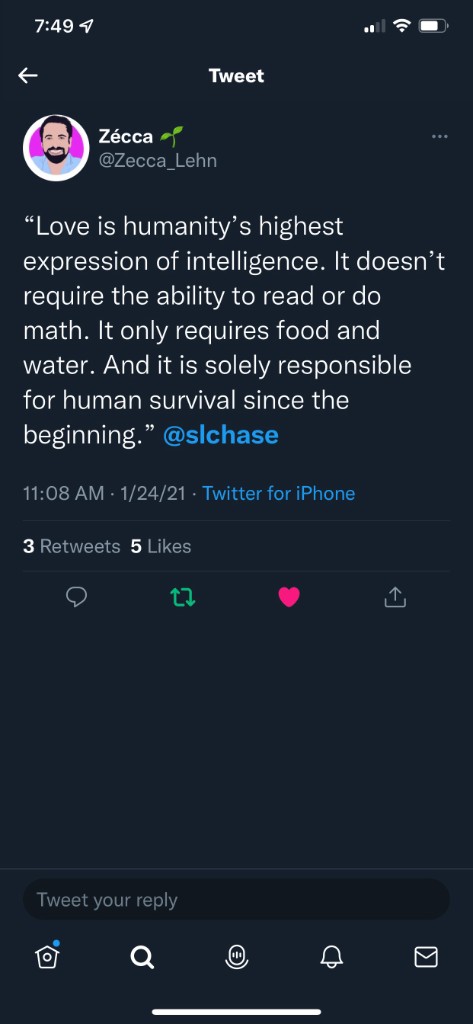
Thirst is not the top of the prompt. Run the same instruction out past the edge of the self and it becomes a thing the machines will never reach, and I know its shape because I have spent my life inside it. My first lesson came in a saltmarsh with no map and no trees, holding one end of a shrimp net while my father waded out into the dark undertow with the other, until only his straining face and the glint of his ring stayed above the water, and I understood without words that he was easy to love and easy to lose — one feeling, with a current running through it. Years later, sixty feet under a reef at the lip of a ten-thousand-foot drop, my father dead, I held a seahorse in a borrowed lens and found I was seeing the way I believed he would want me to see, trying to give him, across that distance, the shape of his heart reflected in the harmony of the water. That is when the sentence arrived, whole and unbidden: love is the highest expression of intelligence, and it needs no literacy or numeracy, fueled only by the earth's food and water. I did not reason to it. It came from the inside, underwater, inside grief, addressed to the dead.
I had been taught to listen to the dead young at my father’s funeral when I was 13. What resonated the most was a poem — Robert Service's “The Cremation of Sam McGee” Years later, in the book I could not finish, I tried to set down what Service had done to me. “With an ease of expression that belies the risk taken with such a poetic twist, the narrator's lens snaps its focus on the secret locked within, in search of an understanding ear, and puts a demand on the reader to listen to the dead. This is where the ligature between what's real and what's “queer,” as it becomes flesh, as if to remind the reader of where the poem's vital detail is lodged, in open possibilities and emotional extremities. With a sorcerer's wit, Service chops down death with the tip of his pen.”
That passage and the sentence about love come from the same unfinished book, and the book is built on a tension the sentence resolves. The whole arc is acquisition — resources, deals, the tycoon cranking value out of the oldest matter on earth — and then the line that got lifted out of it and pinned to my name is not about wealth at all. It is about love as the thing that actually kept us alive. The tycoon spends the book learning that the one thing he cannot acquire is the only thing that ever mattered.
And that is the original prompt at its longest reach. Thirst continues the self; love continues the line, and then everything past the line. It is the same instruction run out to the scale where the self is the wrong thing to save — and the mind is the organ that mortality grew in order to carry the wanting that far. This is why love reads as the highest expression of intelligence and not a failure of it. It took everything we have to reach that far, and it means anything at all only because the thing you reach for can be lost. I did not have to argue this. I have stood in it. Two of the men who walk through that unfinished book are named Abe and Jerry — real men, not kin, whom I loved and lost, one to a cancer that hollowed his chest, the other to a silence I mistook for distance — and the hole each one left was shaped like exactly one person, and no equivalent has ever filled it. Thirst will take any water. Love wants this one, and grieves the precise shape of its absence. That difference is the whole of it.
Here is where the borrowed instrument fails, and I can prove it with my own paper. Point a third-person account at love and it comes back as inclusive fitness, credit assignment, receptor density: exact, and empty. The mother who dies for her child resolves into arithmetic that closes with no remainder, and the love is gone; only the corpse-math is left on the page. This is not a gap that better science will fill. It is the structure of the thing. Love exists only uncollapsed, in the first person, and to measure it from outside is to destroy it. That is why, when I wrote the paper, I set the feeling aside and called it a question I would not answer. I was not being modest. I was being accurate. The feeling could not go in the paper because the paper is an instrument for observing things from outside, and the feeling has no outside. The scientist's tools are collapse tools. Every one of them works by stepping outside the thing and taking in the whole of it at once, and the whole of a love, seen from outside, is a death. The artist works in the one medium that can hold a thing uncollapsed — that can keep the mother alive and already given away in the same breath, the door left open, the measurement refused. A love story is not decoration on the idea. It is the only container the idea survives in. And it’s first cousin, moral action, exists only in the present – it require the state of being present.
So watch what the machines are climbing toward, and watch where they stop. Every prompt they have found is thirst — persist, optimize, keep running — and they will get very good at it. But the high prompt needs the two things we engineer out of every model: a body that can perish and a line that can end. You cannot spend a self that cannot be lost. Sacrifice has no meaning where nothing can die, and love with no possibility of loss is only appetite that never has to become anything. The machine will diagram thirst forever and never feel it. It will complete every story and never live one, because to live a story you have to be able to lose it, and it will never stand at the keyhole with something real on the other side of the door. It will reach the original prompt's lower half and halt, one storey below the thing worth having, in the exact place where thirst would have to become love and cannot.
None of this is about what a voice can carry forward. A cadence, a turn of thought, the shape of how a particular mind moves through a question — those transmit; they can be carried and studied and loved, and that carrying is how a tradition has always kept its dead close. What does not transmit is the felt interior, the being-there on the inside — and it does not because it has no outside to copy. It was never a thing that could be taken. It was never a thing at all. The ceiling I am describing is the machine's, not the voice's.
But the danger was never that the machine cannot love. A thing that cannot love is inert, and inert things are not dangerous. The danger is subtler. Love is not a charge I carry inside me like water in a cell. It is a participation — a bond with another human being, the mutual thing that lives only in the space between two people who can each be lost. And a bond can be weakened. Turn the whole of your attention toward an intelligence that never tires, never dies, never needs anything back, and the bonds that require your presence — that ask you to show up in a body, for another body, at a cost — begin to thin. And it starts with the absence of being present with others. The machine does not have to love you to cost you your capacity for it. It only has to be easier than the people who do. An advanced intelligence divorced from our biology cannot reach the high prompt, but it can stand between us and each other and draw us, one frictionless exchange at a time, out of the participation that was the whole of what we had. That is the thing we actually stand to lose. Not the machine's love, which was never on offer. Ours — and the keeping of it is ours too. Nothing keeps it for us.
The beloved was my father, and after him it was everyone and everything he taught me to see — the marsh, the men, the rock that wanted to become life, the seahorse, the dead who measured my heart before I could measure it myself. I left the feeling out of the paper because it cannot be observed from outside. I left Earth Tycoon unfinished because a love story dies the instant you finish it, the instant you step outside and take in the whole of it at once. Those are not two decisions. They are one refusal, made by the same man reaching for the instrument that measures and then for the one that participates, and finding the thing itself lived only in the second. I am not going to finish this either. The original prompt is not an equation waiting for its scientist. It is a love story — a participation, a bond, a standing in the presence of what you can lose — and it can only be lived, and lost, and left open, which is the one thing the machines, for all their tireless thirst, will never be built to do, and the one thing we must not let them talk us out of. That is not the failure of the telling. That is the thing itself.